Brandi Kruse
Politics • Culture • News
'You’re not actually a journalist': What happens when the government dictates media access
How some Democratic leaders are seeking to crush independent media dissent through rules that seem nearly impossible to apply consistently. 
February 01, 2023
post photo preview


In early October 2022, residents of Seattle’s Chinatown-International District gathered outside a gated-off facility in the city’s industrial south end. Inside, members of the media were invited to tour what would become an expanded shelter and service space for the county’s swelling homeless population.

Chinese elders and other community members held signs protesting plans for the complex, accusing local elected leaders of ignoring their concerns over public safety and pushing the expansion through without the neighborhood’s input.

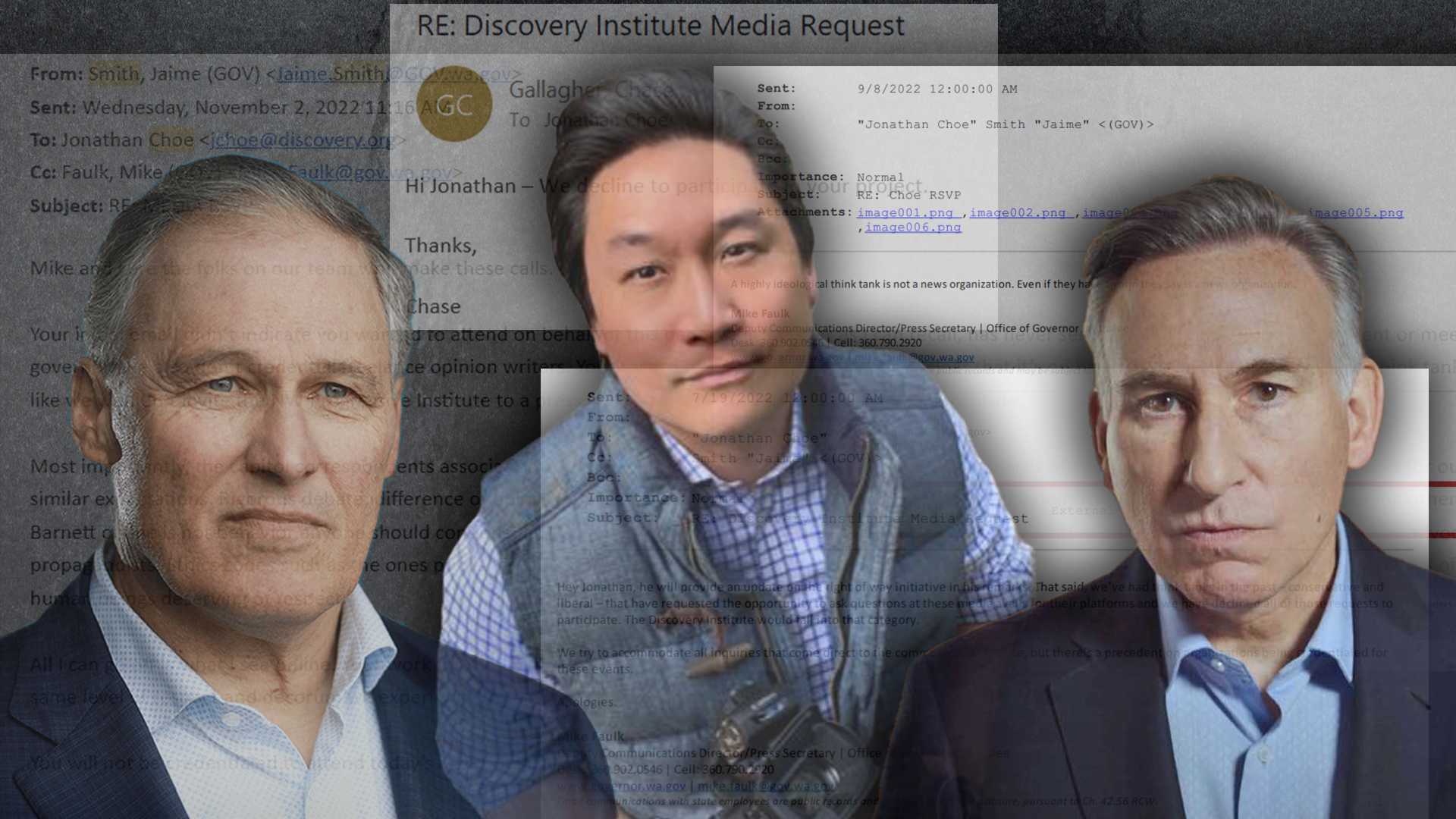
Also outside the gates was Jonathan Choe, a former local TV reporter working as a senior fellow for the journalism arm of a local think tank.

As members of the media were escorted behind the gates to begin their walkthrough, private security guards and staffers for King County Executive Dow Constantine physically blocked Choe from entering.

“You’re not a member of the media, Jonathan,” said Chase Gallagher, a one-time press staffer for Governor Jay Inslee who now works as communications director for Constantine.

“Jonathan don’t be defensive about this, don’t make a scene.”

Choe was indignant. His coverage of the planned homeless complex was the reason other media outlets were interested in the story in the first place. He’d spent an extended amount of time covering concerns in the Chinatown community before any of the legacy newsrooms paid attention.

“I’m trying to go in and cover for the community what this is about,” Choe said, standing near the gate.

“Well, the media is here. You’re not a member of the media,” Gallagher replied. “That’s the facts.”

1.png?token-time=1676505600&token-hash=7AQpmt7lsDuAp2C2YUwD0MaeCQ6bN8P1i9GZwBOvpTw%3D

Independent journalists have long been an accepted part of Seattle’s media landscape – today more than ever. With the continued downsizing of legacy newsrooms, these journalists help fill the gap, offering important viewpoints and niche coverage of issues that would otherwise be overlooked.

Only recently, more options have emerged to offer a critical counterpoint to Washington state’s prevailing progressive narrative. The success of those outlets depends, in part, on the willingness of public officials and elected leaders to recognize them as part of the media ecosystem.

Therein lies the problem.

Some of the state’s top Democratic officials and their staff have actively sought to blacklist these dissenting voices – changing internal policies around who can access press conferences, whose email inquiries are answered, and who is deemed to be a “real journalist.”

Over the past several months, unDivided reviewed hundreds of documents, emails, and text messages obtained through public disclosure requests. Taken together, they paint a troubling narrative of how some Democratic leaders are seeking to crush independent media dissent through rules that seem nearly impossible to apply consistently. 

“I think we need to nail down a policy for how we respond to WPC, and others like Choe or Kruse or Center Square,” read an August 22 email from Mike Faulk, the deputy communications director for Washington Governor Jay Inslee. Faulk wrote the email to Jaime Smith, Inslee’s executive communications director.

1.png?token-time=1676505600&token-hash=6QkL8Yj0hHeCclIlZBFyCXmtuTsgrhI_tbGeGxX2oH0%3D

His email was in response to a request from Elizabeth Hovde, who writes about healthcare and labor for the Washington Policy Center, a center-right think tank that advocates for free-market solutions.

Hovde was seeking clarity on some confusion in how a state labor union was interpreting Governor Jay Inslee’s vaccine mandate.

“I’ve been ignoring WPC’s inquiries because I don’t think they’re legitimate or coming in good faith,” Faulk told Smith. “I see you respond occasionally – and I’m sure that’s why Hovde reached out to you – so I just want to be consistent.”

Faulk’s email was particularly telling. Despite dozens of independent journalists and outlets in the state, many of which have a political agenda or outside funding, he specifically listed those known to offer less favorable coverage of Democrats: The Washington Policy Center, Center Square, Jonathan Choe, and yours truly.

Why?

The answer may seem obvious – but understanding the selectivity at play is far more complicated.

When I left my job in TV news in November of 2021 to launch the unDivided Podcast, I worried what it might mean for my access to elected leaders. At the same time, I was one of the longest-serving journalists in the market. I’d spent 13 years building trust, connections, and respect as one of the state’s only full-time political reporters.

For those reasons, I enjoyed a relatively soft landing in the world of independent media.

Jonathan Choe didn’t have the same luxury.

Choe began as a reporter in Seattle in April 2020, just after the onset of the pandemic. Much of his first two years with KOMO-TV were spent trying to cover issues virtually – a difficult way to build relationships.

1.png?token-time=1676505600&token-hash=-dZiThEtTcEDMiYAD8ST2DfsYXlk337uj3LMNNr9WCQ%3D

In March 2022, Choe was fired by KOMO after publishing a video on social media that highlighted a Proud Boys’ rally outside the state capitol. The city’s alt-Left social media mob, which already disliked Choe for his coverage of Seattle’s drug epidemic, called his video propaganda for the far right. It didn’t take KOMO long to relent.

Undeterred, Choe went to work for FixHomelessness.org, the journalism arm of Discovery Institute – a conservative think tank. Choe said he was clear with his new bosses upfront: he wanted full autonomy to do in-depth reporting on homelessness.

While government offices initially responded to his email requests and included him on lists for press releases, those communications quickly faded.

“Brandi, do you get the emails for Mayor Harrell’s press conferences?” Choe sent me in a text on August 31, 2022.

“Yes,” I responded.

“You’re not going to believe this, but the mayor’s media team has iced me out. So has Dow Constantine,” he wrote. “Could you please let me know moving forward when the mayor’s next physical press conference will be?”

Indeed, internal emails from that time show Choe’s inquiries going unanswered. Sometimes, Mayor Bruce Harrell’s communications director would simply forward the emails to other members of the team as an "FYI" but offer no response.

At the same time, when Choe did manage to find out about an in-person event, Mayor Harrell happily took his questions.

“He’ll see me, and he takes the time and does his best to answer my questions, so I don’t know what’s going on with the mayor’s press team – whether they’ve been given any guidance from the mayor not to invite me to these events.”

1.png?token-time=1676505600&token-hash=ToqQpymM0KfD1C1iIvMK-BQfg5RN1nDqkA0zxwGyo0o%3D

Choe said he did attend an in-person mayoral press conference toward the end of 2022 without an RSVP and was not turned away – although he was not directly notified of the event either.

“As of now, I’ve not been technically blocked form any of the mayor’s press conferences or events,” he said.

The same is not true for King County Executive Dow Constantine.

Before the infamous incident outside the homelessness complex near Chinatown, tensions between Choe and the executive’s office were high.

In September, Constantine refused to answer questions from Choe at a press availability. Choe, not one to be ignored, followed Constantine out of the room (camera in hand) and continued his line of questioning.

“You’re not actually a journalist, you were fired for promoting the Proud Boys,” Constantine told him. “So, we talk with reporters like those in the room.”

With that, Constantine disappeared into a private elevator.

1.png?token-time=1676505600&token-hash=iuRFo8B4cWaQ2331Yl_flJ355-cqJkzWCCSCJojRoP0%3D

A member of Constantine’s staff tried to appease Choe, telling him to direct questions to relevant departments.

“Your office is not responding to me, that’s the problem,” he said.

“You are not with a media outlet that is our focus,” the staffer responded.

What media outlets are their “focus”?

Behind the scenes, Executive Constantine’s office had been responding to Choe’s requests with various versions of the same line: “We decline to participate in your project.”

1.png?token-time=1676505600&token-hash=iyXF9ww1Q53mrjlPPN20WWDFWe0m8f2fOIC3zcVFzKk%3D

Communications Director Chase Gallagher also encouraged other county departments not to treat Choe as a member of the press.

“Since the Discovery Institute is not a media organization (it is an agenda driven think tank) we do not need to treat these inquires as media requests,” Gallagher wrote in a June 23rd email to spokespeople for other county departments.

1.png?token-time=1676505600&token-hash=HPZoOxWp00BaE-HhHcMYlln2lru3IFgycfGIMop2nO4%3D

At the same time, those departments would prepare themselves for other media requests on the same topics – noting that Choe’s coverage was sure to bring additional attention to the issues (which is what good journalism does).

The office of Washington Governor Jay Inslee has taken a slightly different approach to requests from Choe, but one that raises questions about whether their rules for media outlets can be applied consistently.

As far as the governor’s office is concerned, Choe’s employment by a think tank disqualifies him from attending press availabilities at the governor’s office.

“We’ve had think tanks in the past – conservative and liberal – that have requested the opportunity to ask questions at these media avails for their platforms and we have declined all of those requests to participate,” Deputy Communications Director Mike Faulk told Choe in a July 19 email. Choe had attempted to RSVP for a media availability with the governor on his efforts to clear encampments on state property.

unDivided has asked the governor’s office to provide examples of other think tanks who have been denied access to media briefings. This story will be updated accordingly. 

In a similar email exchange on September 8, Choe pressed Faulk on how the office was adjusting its requirements to adapt to the changing media landscape.

“A highly ideological think tank is not a news organization,” Faulk replied. “Even if they have an arm they say is a news organization.”

In several emails, both Faulk and Jaime Smith agreed that they would still try to respond to factual inquires for information from Choe and anyone else.

The governor’s office said it made decisions about access based, in part, on guidelines set forth by the Capitol Correspondents Association. Those guidelines detail what organizations or journalists can be credentialed to cover events at the statehouse.

1.png?token-time=1676505600&token-hash=In2wU0hUIN7vQrVS18OgS9ptHWeSZqT1OnsH6s5p9a0%3D

Certainly, the credentialing requirements also frown upon journalists who are affiliated with lobbying, political campaigns, or who are employed by a non-news organization.

1.png?token-time=1676505600&token-hash=OoIqc9fm588lQxXGaODa09p16pCA7br0e_U5n0XkBcc%3D

One could reasonably argue that separating think tanks or lobbyists from the ranks of media members is sound policy – but that line is increasingly blurred as news agencies look to outside funding sources to compensate for dwindling revenue.

For example, The Seattle Times’ Project Homelessness is funded by outside entities, some of which are clearly ideologically driven. The Times discloses the funding at the top of each story put out under the Project Homelessness banner and notes that they maintain editorial control.

Should that funding keep The Times from attending press conferences at the Governor’s office?

How about The Center Square?

The Center Square covers politics in states across the country, including Washington, with a focus on economic issues. While some argue its coverage is conservative, it’s no more to the right than most mainstream publications are to the left. Readers can donate to support the work, but it is funded through the Franklin News Foundation with a goal of delivering statehouse coverage where legacy newsrooms are falling short.

For any discerning person, The Center Square’s stories are well reported, timely, and informational. Yet, you’ll recall that August 22 email from Mike Faulk:

1.png?token-time=1676505600&token-hash=OzX-vhWMrVITU7UM2m6C_LrfEu5YLYtD-lGbjpdlxiY%3D

Should one of the only outlets providing balanced and consistent coverage of the statehouse be denied access to the governor because of their funding source? Even as other outlets downsize?

I’d be remiss if I didn’t address the fact that I, too, was listed on Faulk’s email.

Just last week, Governor Inslee did a lengthy interview with me in my capacity as a fill-in host on KIRO Radio. Yet, in my full-time job hosting the unDivided Podcast, technically I would run afoul of their standards.

While the majority of unDivided’s revenue comes from listeners who pay $5 per month to support the show, we also (like nearly every media outlet) rely on ad revenue. Each Monday, we run a branded segment as part of a partnership with Future 42 – an arm of Project 42, which is a non-profit that advocates for personal liberty and free-market solutions in Washington state. Project 42 operates based on donations and does not contribute to political campaigns or committees.


Like The Times’ Project Homelessness, I maintain editorial control over the content in these segments.

See how quickly these rules can get confusing?

If Choe’s employment by a think tank was the only thing keeping him from gubernatorial press conferences, reasonable people could disagree. But then came this bizarre email admonishing Choe for his behavior on social media.

“…your online conduct does not reflect the same level of respect and decorum we experience from the credentialed reporters who attend events hosted by the governor and Legislature.”

1.png?token-time=1676505600&token-hash=_5HBQW7S6Di7DI2cB4utbPfPtj_hy7kKDsedyI5fa6c%3D

How does the governor’s office plan to police social media behavior as a condition of access?

After all, Erica Barnett, a local blogger who Smith accused Choe of attacking online, is herself is one of the wort offenders of social media misconduct. She has personally attacked my Twitter followers, calling them “troglodytes” and other condescending names. In 2020, she called for me to be fired, claiming I made up a story about a rioter firing a stolen police rifle, even going as far as to tag my employer in a Tweet. Barnett was later forced to back away from her claim when video surfaced showing that the incident had, in fact, occurred as reported. 

So, would Barnett be banned from the governor’s press conferences because of her online behavior?

The governor’s office put out its own guidelines around credentialing in October 2022, with a section on professional conduct.

1.png?token-time=1676505600&token-hash=A4ueREycLUs4YFborvMsigncW0GB4TaX9-cvvssWw2k%3D

It seems reasonable, but I would also point out that a member of the governor’s press team seems to run afoul of their own rules on social media behavior. 

Faulk, the deputy communications director, has sent several tweets attacking members of the media.

In another Tweet, he told Missouri’s Republican governor to “eat shit.”

1.png?token-time=1676505600&token-hash=zfQ4KOAt9MzW6sXyQx38IKpV8IN9kv_0k8rhNvd6d_M%3D

At the very least, the tweets from Faulk raise serious questions about his ability to treat members of the media fairly.

Conservative radio host Ari Hoffman on 570 KVI provided me with an email exchange between he and Faulk.

In it, tensions are so high that Faulk demanded to speak to Hoffman’s boss. Without listing specifics, he said Hoffman had “repeatedly, knowingly spread lies in your ‘coverage’ of what the state is doing. You have no professional ethics. Goodbye.”

1.png?token-time=1676505600&token-hash=7tiduRF_RdFURKGyQraxEo1xRFsckTyFj-uXiUGMpEk%3D

Can Faulk, who is a public employee, be trusted to decide who the journalists are? Can anyone in government?

I asked Choe how he believes elected leaders should navigate this brave new media world.

“There aren't enough bodies left to cover these press conferences," he said. "Work with men and women who do journalism full time, regardless of differences in opinion or any perceived bias. Examine their entire body of work before making a decision about access. And just know, independent journalists like me are on the rise. So, if you are going to block me from press conferences because of my connection to a think tank, you better reevaluate how every other journalist is being funded.”




community logo
Join the Brandi Kruse Community
To read more articles like this, sign up and join my community today
7
What else you may like…
Videos
Podcasts
Posts
Articles
WATCH: Not forgotten after all (5.20.26)

Trump’s Department of Justice is targeting several radical policies in Washington state. State lawmaker faces public hearing in ethics probe. Activists demand Seattle mayor declare ‘emergency’ for trans refugees. Gavin Newsom is getting really, really scary.

Prefer to listen? https://audioboom.com/posts/8906058-not-forgotten-after-all-5-20-26

01:05:42
WATCH: How the media weaponizes ‘trans’ (5.19.26)

A trans identity is embraced when sympathetic but ignored when problematic. Washington state spent millions on top and bottom surgeries for prisoners. Seattle mayor claims to regret “bye” comment. Feds charge woman for skid row election fraud.

Prefer to listen? https://audioboom.com/posts/8905576-how-the-media-weaponizes-trans-5-19-26

01:01:32
WATCH: Spreading hate in Washington state (5.18.26)

'No Hate in WA State' is quickly becoming the most hateful political entity in existence. Seattle police union worries about World Cup safety. Drug addicts told it’s OK if they kill their pets. Anti-racist missing person alerts are actually really, really racist.

Prefer to listen? https://audioboom.com/posts/8905092-spreading-hate-in-washington-state-5-18-26

01:10:01
REMARKS: 'A fundamentally different approach to government'

These remarks were delivered to the Snohomish County Lincoln Day Dinner on May 17, 2024.

REMARKS: 'A fundamentally different approach to government'
'The Final Battle': Remarks to the Whatcom County Republican Party

The following remarks were delivered to the Whatcom County Lincoln Day Dinner on March 23, 2024, in Ferndale, Washington.

I struggled with what to talk to you about tonight. 

Well, that’s not true. I didn't struggle with what to talk to you about – I struggled with whether I was brave enough to say what I wanted to say. 

When I'm invited to speak to groups, I don't want to offend anyone or be too controversial. So, I reached out to a few of your fellow party members to ask whether any topics were off limits or wouldn't go over well with the crowd. 

I got some good advice. 

Then I decided to ignore that good advice entirely.

Too much is at stake to be polite. 

As we sit here tonight, we are in the final battle of a war. 

A war that has pit sanity against insanity. 

Pragmatism against idealism. 

A war that has sacrificed the public good, in favor of a twisted idea of progress.

It's a war that began long before I moved here 15 years ago. It started silently and it was mostly waged in the shadows.

Most of us didn't even realize that a war was being fought. We were too caught up in our own lives and our own problems. ...

'The Final Battle': Remarks to the Whatcom County Republican Party
INTERVIEW: Congressman Dan Newhouse

During a visit to Eastern Washington, Brandi sat down with Congressman Dan Newhouse (R-WA04) to discuss the fentanyl crisis, fuel costs, border security, Chinese land acquisition, and how he was able to survive his vote to impeach Donald Trump.

INTERVIEW: Congressman Dan Newhouse
LIVE: Not forgotten after all (5.20.26)

Trump’s Department of Justice is targeting several radical policies in Washington state. State lawmaker faces public hearing in ethics probe. Activists demand Seattle mayor declare ‘emergency’ for trans refugees. Gavin Newsom is getting really, really scary.

LIVE: How the media weaponizes ‘trans’ (5.19.26)

A trans identity is embraced when sympathetic but ignored when problematic. Washington state spent millions on top and bottom surgeries for prisoners. Seattle mayor claims to regret “bye” comment. Feds charge woman for skid row election fraud.

post photo preview
We fight on – because what other choice is there?
They can try to destroy my reputation. It still won't put them on the right side of history.
 

This week, progressive political strategists launched an effort to undermine my support of citizen initiatives – arguing that my opinions are no longer protected by the First Amendment and should therefore be regulated by the state.

You read that correctly.

In a 24-page complaint to the Washington State Public Disclosure Commission, an obscure organization that styles itself as Washingtonians for Ethical Government called for an immediate investigation into my public support of two voter initiatives that will appear on the ballot in November – one to protect girls' sports, the other to restore parental rights.

Kruse is possibly the most prolific of political content creators in Washington, and her promotions of Let’s Go Washington’s initiatives do not qualify as editorial content. Kruse is not an impartial journalist or just an opinionated member of the public; she is a commercial advertiser with multiple advertisers. Although Kruse was once employed as a reporter by bonafide news outlets, she is no longer commonly considered as a journalist in Washington State and was recently denied press credentials by the Washington State Capitol Correspondents Association, a decision that was upheld by both state and federal courts.

Their argument goes something like this:

  • I host a podcast.

  • My podcast sells spots to advertisers.

  • I endorse products for said advertisers.

  • Therefore, my endorsements have value.

  • Therefore, my political endorsements have value.

  • Therefore, any political endorsements I make must be reported to the Public Disclosure Commission as “in-kind” donations.

There are several factual inaccuracies with the complaint, like the assertion that state and federal courts have determined I’m not a journalist. That is false. While a federal judge declined an emergency motion to have my press pass reinstated in the final days of the 2026 legislative session, our case is ongoing and only in the early stages. I am confident we will prevail.

There are also several legal issues with the complaint, not the least of which is a pesky little thing called the First Amendment to the U.S. Constitution.

But don’t be fooled – the goal of the complaint isn’t for it to stick. The goal is to harm my reputation in the court of public opinion.

Still, for the sake of posterity, it’s worth noting a few things:

The government cannot assign a numerical value to my political speech. Such an act would be extraordinary and without precedent in the history of the United States.

I have never received anything of monetary value to support or oppose any political candidate, initiative, or issue. Quite the contrary. I have given untold hours, made personal donations, and driven tens of thousands of miles around the state to lend my voice to issues and people I believe in.

I have the right to charge advertisers for endorsements, or to provide endorsements free of charge if I wish. And I have. In the years following the pandemic, I featured local small businesses on my show free of charge – and gave them attention on social media, urging followers to support businesses that were struggling to recover from government-imposed lockdowns. I also did this in 2020 while still employed as a news reporter at FOX 13 in Seattle, running a weekly segment on my political show called “Small Business Sunday.”

Providing paid endorsements of products is a common practice in broadcasting and has been for decades. Many of our current advertisers were once endorsed on the radio by the late Dori Monson. Several local radio hosts who endorse products on air have also made public statements about their support of current voter initiatives. Ari Hoffman of KVI and John Curley of KIRO Radio not only endorse products but have stood alongside me in support of girls and parents.

If the Public Disclosure Commission were to rule that my speech must be regulated, it would also have to start regulating the speech of dozens of mainstream radio hosts – and perhaps even the Editorial Board of the Seattle Times.

Beyond that, this issue is settled law in Washington.

The Washington State Supreme Court ruled in 2007 that endorsements from talk show hosts do not constitute in-kind contributions.

At the time, radio hosts John Carlson and Kirby Wilbur were organizing and promoting Initiative 912, aimed at stopping an incremental increase in the gas tax.

'The mere fact that a broadcast has value to a campaign, or includes solicitation of funds, votes, or other support, does not convert commentary into advertising when it occurs during the content portion of a broadcast for which payment is not normally required,' Justice Barbara Madsen wrote for the court.

But again, the point of the complaint is not to upend existing law or get the government to throw the First Amendment to the wind.

The progressive political strategists behind the stunt, Powerhouse Strategic, is the firm used by opponents of the Let’s Go Washington initiatives.

Few news outlets that covered Tuesday’s press release saw fit to mention this connection. Why? It’s not as if it’s a secret. Kristin Hyde, a communications specialist with Powerhouse Strategic, sent the release out with her name and contact information on it.

Powerhouse not only brought previous PDC complaints against Let’s Go Washington, but it also represents the Washington State Democratic Party, as well as two of the largest unions bankrolling the anti-initiative campaigns: SEIU and the Washington Education Association.

1.png?token-hash=Rsuomg_82zpfRv9wDl5Yj5pls7-whh7ucO_ZK0G6vE8%3D&token-time=1779926400

Still, The Seattle Times characterized Washingtonians for Ethical Government (WFEG) only as a “campaign finance watchdog.”

Even if it were a legitimate watchdog group and not a cover for deeply partisan operatives, in the past 10 years it’s only ever questioned the “ethics” of conservatives.

1.png?token-hash=kEF0Gl5391E8QNe-c3xP0lSO4rvB-K86pbSiK_lUup0%3D&token-time=1779926400

In case there was any doubt, I fully intend to continue my work fighting for what I truly believe is the women’s rights issue of our generation: the erasure of girls at the hands of ideologues.

After all, I was fighting this issue long before Let’s Go Washington decided to run initiatives to change state law. In fact, it was through episodes of unDivided that LGW met two of the teen athletes – Ahnaleigh Wilson and Frances Staudt – who would go on to become important voices in the campaign to protect female athletes. I like to think our coverage of the issue is a big reason why voters will get a say in November. I am very proud of that.

1.jpg?token-hash=j3Zy8oY8oJaza2PZlQJDQgdNdSeRb2Z5ArWk7-muENI%3D&token-time=1779926400
Me with Frances Staudt (left) and Ahnaleigh Wilson (right) at a signature gathering event in Issaquah, Washington.

I will also keep fighting for parental rights, as I was before LGW started collecting signatures for a parental bill of rights. My advocacy on this issue goes back to 2023, when I helped a rag-tag group of citizens collect signatures to try to run a referendum on Senate Bill 5599. The law allows children to be hidden from parents if they don’t think their family approves of their gender identity. I was protested, threatened, and called a transphobe. All the usual stuff. The referendum fell short, but my motivation to help parents keep their families together only grew.

1.jpg?token-hash=g-4GoyPQwU1zwfq1NCZjpaAVuIv9Pne4dj5jOTCWOPQ%3D&token-time=1779926400
Protesters greet us outside a coffee shop in Lacey, Washington, where we were collecting signatures to repeal SB 5599.

As I said on my show this week: They can try to bankrupt my business. They can try to destroy my reputation. They can even try to kill me. None of it puts them on the right side of history.

So, we fight on. What other choice is there?


Read full Article
post photo preview
The Constitution Wars start NOW!
In response to Governor Bob Ferguson auctioning off a signed copy of the Constitution (blasphemy), we're auctioning off our own to the highest bidder! The winner will get a personalized inscription from Brandi, and she will hand deliver it (within 150 miles). All proceeds from the winning bid will go to We Heart Seattle, as selected by unDivided subscribers. Donations are tax deductible. Place your bid here.

Read full Article
post photo preview
Guest: How to investigate fraud when the media and politicians won't
How a citizen with an art degree uncovered more about potential childcare fraud than the legacy news

About the author: Kristen Magnuson is a Washington state resident and citizen sleuth who helped uncover a troubling pattern with childcare payments in Washington state that mimicked alleged fraud in Minnesota. Follow her work on X at @KristenMag.


On the morning of December 28, I settled in with a cup of coffee to catch up on the latest Minnesota fraud news. I’d heard rumblings of the scandal for weeks after County Highway and City Journal published pieces describing the schemes in startling detail.

Earlier that week, independent journalist Nick Shirley released a viral video investigating Minneapolis daycare centers, focusing on several owned and operated by members of the Somali community. His videos weren’t definitive proof of fraud, but like many Americans I was left with questions that were too big to ignore.

So, what was I going to do about it?

I’ve always had a knack for pattern recognition and making sense of data. I fully admit I’m not professionally trained in this capacity. I have an art degree. I’m just a concerned citizen who wanted to take a closer look at how our tax dollars are being spent.

Here’s how I went about uncovering suspicious activity that was later highlighted by Elon Musk, viewed by millions of people, and led to on-the-ground investigations by independent journalists (and even some legacy news stations in Seattle). 

It started with a simple search

My initial efforts were not sophisticated. I simply typed ‘childcare wa’ into a search engine. I never anticipated that such a basic exercise in sleuthing would spark the local and national attention that it did.

I landed on the state website for the Department of Children, Youth, and Families (DCYF). Among other things, the site serves as a tool for families to find childcare options. It lists every provider in the state, with information on the owner, address, capacity, inspection history, and language.

I toggled the filter to show daycares participating in the Early Achievers rating program, which is a requirement for receiving state funding. From there, I filtered results to show only the daycare operators listed as speaking Somali.

Is it racist to single out one ethnicity?

The Minnesota fraud scandal had already established a clear pattern of fraud within the Somali community, resulting in multiple prosecutions and guilty pleas.

It’s not racist to explore whether similar patterns might exist in other states, too.

Consider this excerpt from Armin Rosen’s County Highway piece:

If one chooses to inhabit a fact-based world, it is impossible to ignore that the most thoroughly proven frauds, the ones that have dollar amounts and dozens of federal prosecutions attached to them, involve the distribution of social services through organizations serving Somali-Americans.

In a City Journal article, Christopher Rufo highlighted a whistleblower who reported that the Minneapolis Somali fraud ring may have a potential link to Seattle.

According to Glenn Kerns, a retired Seattle Police Department detective who spent 14 years on a federal Joint Terrorism Task Force (JTTF), the Somalis ran a sophisticated money network, spanning from Seattle to Minneapolis, and were routing significant amounts of cash on commercial flights from the Seattle airport to the hawala networks in Somalia. One of these networks, Kerns discovered, sent $20 million abroad in a single year. 'The amount of money was staggering,' Kerns said.

Ignoring evidence and patterns over concerns about being called racist is how fraud goes unreported and uncovered.

In my initial search of Somali-run daycares in Washington state, I found that of 5,046 total Early Achievers childcare providers, 539 were Somali speaking. That’s more than 10%. Census reports estimate less than .2% of Washington state’s population is of Somali descent.

That seemed oddly disproportionate, so I posted a scrolling video on X to show what I found.

Hours later, I casually checked my notifications while at the grocery store and saw that Elon Musk replied! Millions of people were suddenly interested in what I’d uncovered with a simple search of publicly available data.


Day 1: Investigating on the ground

The day after my X post went viral, independent journalist Jonathan Choe pulled up to my house. We spent the next four hours driving all over town investigating daycares in person. I’d never done anything like it.

While state leaders, including Washington’s Attorney General and several Democrats in the legislature, would later accuse us of harassing daycare owners, we did no such thing. We were friendly. We knocked on doors. We politely asked for an application to enroll a child. Many of the people who came to the door were friendly in return.

At the first daycare, a woman invited us inside for a tour. There were activity tables with child-sized chairs, nap mats neatly stacked, art on the walls, age-appropriate books arranged on a shelf.

While everything looked legitimate, the woman would not give us an application, and I noted that only one child was present at the time.

As we ventured to other locations, we encountered some obvious red flags. Windows fully covered, no signage, and very few outdoor play areas. Most of the people who answered the door told us the owner was not there. They asked us to come back another time. Most significantly, we rarely saw or heard any kids.

At the last spot a woman spoke to us through a doorbell camera.

“We don’t have childcare,” she said.

The windows were fully covered.


Day 2: Trouble with the police

On our second day visiting Somali-run daycares listed on the state website, we met up with local journalist Carleen Johnson of The Center Square.

At one site, a woman spoke to us from behind a closed door. She wasn’t willing to give us an application. We asked a few more brief questions, thanked her, and started walking away. Shortly after, two women came out of the house to scold us.

Someone had called the police.

A responding officer assured us that we were not trespassing or doing anything wrong. The women allowed him to look inside the home, and he confirmed that there were kids inside.

The hostility was surprising. By then, a local KOMO News reporter was doing similar work – knocking on doors and asking questions. Basic shoe-leather journalism. Not harassment. Not racism.

We continued throughout the city. Some of the places we visited looked like real daycares, but many did not.

We detailed our findings on social media.


Day 3: Where has all the money gone?

We began looking deeper into the publicly available spending data on the Washington State Fiscal Information website. This site, also known as Open Checkbook, discloses provider payments by month and fiscal year. Our third day was focused on visits to providers that received significant amounts of funding.

Another independent journalist, Cam Higby, was with us as well.

Many of these small home daycares were receiving hundreds of thousands of dollars in taxpayer funds each year – some got more than a million. Keep in mind that most of these daycares have a maximum capacity of 12 children.

At one address we visited, a man spoke to us from a porch camera. He told us it was not a daycare.

Another alleged daycare was listed at the address of a small, run-down house. The windows were covered. We didn’t see or hear any children. Besides a tattered basketball hoop sitting in a mud puddle at the edge of the property, there was no play equipment. The woman who answered the door was friendly but declined to provide us with any information or an application.

Our team asked two neighbors if they had seen kids at the house and if they were aware it was registered as a daycare.

Both neighbors said no.

Yet, according to state data, the childcare provider listed at that address receives six-figure monthly payments, bringing in over $160,000 in July alone.

As I expanded my research, I checked out the state’s most recent audit. The Washington State Auditor’s Office reviews federal funding annually. Findings are published in a formal report, with highlights summarized on the auditor’s website. The 2024 fiscal year audit exposed significant concerns, including a whopping $416 million dollars in “unauditable” DCYF spending.

The audit revealed that DCYF repeatedly failed to comply with reporting requirements and had more audit “findings” than any other agency.

Despite being given corrective actions to take, similar findings have plagued DCYF for years.

“For the fourth year in a row, we are questioning all childcare payments from the Child Care and Development Fund at the Department of Children, Youth, and Families,” the Auditor’s Office stated.

Read that again. The auditor’s office has questioned ALL federal childcare payments to DCYF for the past four years. Hundreds of millions of dollars in questionable payments.

How is such a blatant failure to follow reporting requirements or enact corrective action even allowed?

I posted a thread summarizing the audit findings on X. Before long, other news outlets and political figures were amplifying what I found.

The strange thing is that the audit findings were never private or hard to uncover. They were right there on a government website for all to see, for years. Why did it take a citizen with an art degree in Washington state to shed light on them?

Knowledge is power, but what comes next?

I want to be clear that I am not alleging fraud at any of these daycares. I do not have the tools or authority to do so. But we, as citizens, do have the tools to spot concerning patterns and question government oversight of our money.

Thanks to social media, we can amplify our concerns so that officials who do have the tools and authority to investigate can be pressured to do so.

State officials have seemingly ignored these red flags for years. Our questions and concerns are fair. We are not racists for recognizing patterns and asking questions.

Our elected officials owe us transparency – and if the media won’t demand it, we should.

About the author: Kristen Magnuson is a Washington state resident and citizen sleuth who helped uncover a troubling pattern with childcare payments in Washington state that mimicked alleged fraud in Minnesota. Follow her work on X at @KristenMag.


Read full Article
See More
Available on mobile and TV devices
google store google store app store app store
google store google store app tv store app tv store amazon store amazon store roku store roku store
Powered by Locals